Hydraulic Press Machine Buying Guide: Capacity, Tonnage & Price Range for Indian Manufacturers
Spend even an hour looking at hydraulic press machines online, and the options quickly become overwhelming. Different tonnages, different frame types, prices that vary wildly between suppliers, and specifications written in ways that assume you already know what everything means. Most manufacturers buying a hydraulic press for the first time do not know where to start. And even those upgrading from an older machine often find that what worked ten years ago will not necessarily work for today’s businesses. This article is all about the two different yet important things: how much tonnage you actually need, which type suits your work, what prices look like in India right now, and what to confirm before placing an order. Nothing complicated.
How to Choose the Right Hydraulic Press Tonnage?
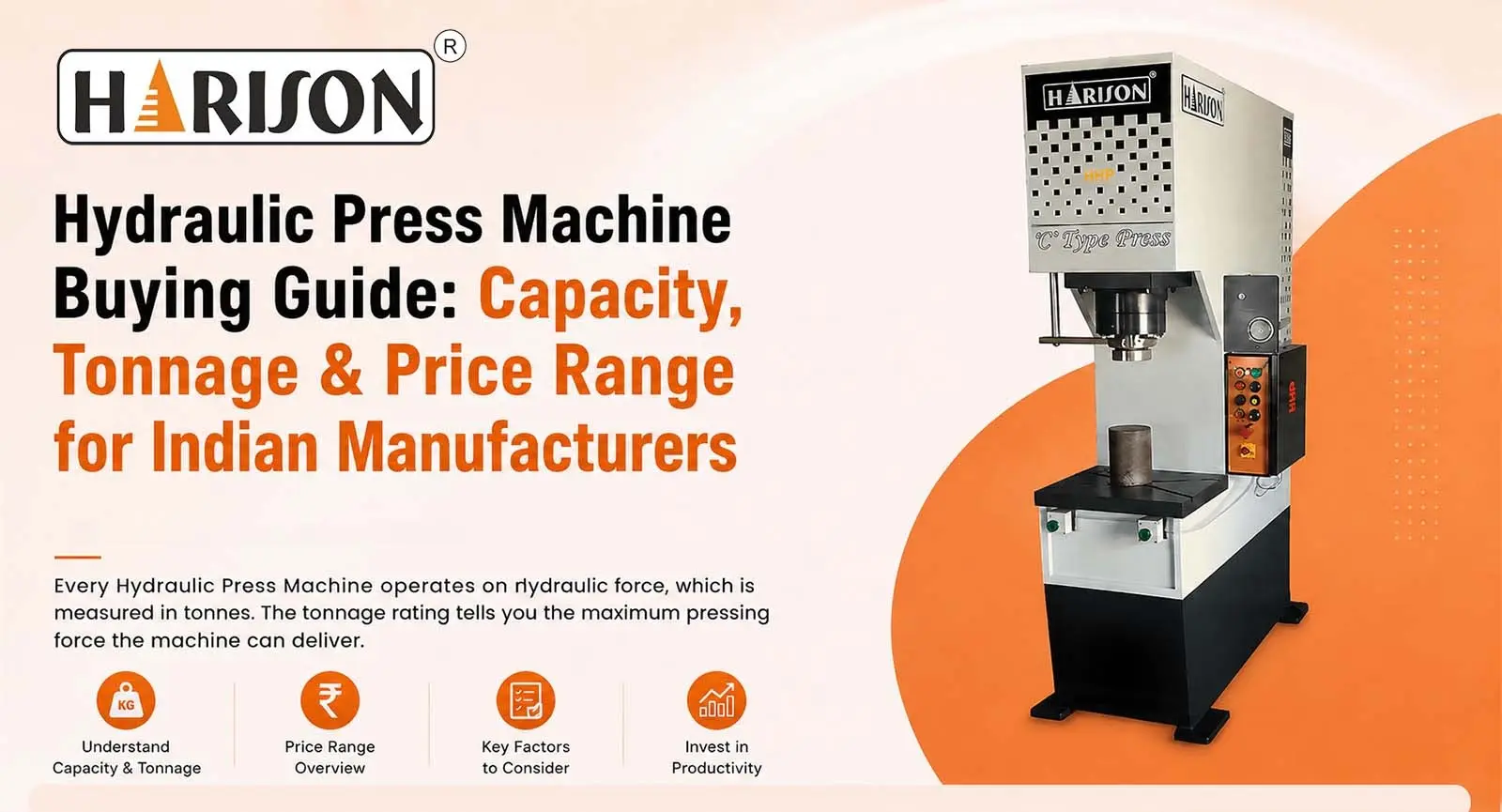
Every Hydraulic Press Machine operates on hydraulic force, which is measured in tonnes. The tonnage rating tells you the maximum pressing force the machine can deliver.
Getting this number right is the most important part of the buying process. Too low and the machine cannot handle your work properly. Too high and you are spending money on capacity you will never use, plus running a machine that is physically larger than your floor space and power supply needs.
Here is how tonnage maps to common applications:
- Work like punching, light bending, and general assembly on thinner materials usually needs somewhere between 10 and 50 tonnes
- Automotive component manufacturing, stamping, forming, and drawing sheet metal typically calls for 100 to 300 tonnes, depending on part size
- Heavy forging and thick-section forming start at 300 tonnes and go higher for large cross-section work
- Rubber and plastic moulding depends mostly on mould area, but 50 to 200 tonnes handle most standard work
If your application does not fall cleanly into any of these, just tell the manufacturer your material type, thickness, and the operation you are performing. They will calculate the tonnage required and will tell you which hydraulic press machine is best for your business.
Different Types of Hydraulic Press
Tonnage tells you how much force the machine can apply. The type tells you how that force is delivered and what kind of work the machine is built for. These are different things and both matter. Let’s discuss some of the different and demanding types of hydraulic presses:
- H-Type Hydraulic Press
This is the most widely used hydraulic press machine in Indian manufacturing. The frame is rigid, the machine handles a wide range of operations, and it comes in almost every tonnage range. For general pressing, straightening, bearing work, and assembly tasks, this is where most buyers land, and for good reason. It is versatile and well-supported by most manufacturers.
- C-Type Hydraulic Press
The open front design on a C-frame press means the operator can load and position workpieces from three sides without any obstruction. That makes it practical for work where parts need to be moved and repositioned during the process. The downside is that the open frame is less rigid under high loads, so this type works best for lighter applications.
- Four Pillar Hydraulic Press
Four precision columns guide the ram straight down, which gives completely even pressure distribution across the full platen area. If your work involves rubber moulding, laminating, or sheet metal forming, where uneven pressure would affect the part quality, this hydraulic press machine performs noticeably better than an H-frame for those specific operations.
- Deep Drawing Hydraulic Press
This one is built for a single purpose, forming sheet metal into deep shapes like cups, shells, and housings. It has specific stroke characteristics and cushion systems that general presses do not have. If deep drawing is not your primary operation, this is not the right machine.
Each hydraulic press type is built for a different kind of industrial work, so the right choice depends less on what looks powerful on paper and more on what actually fits your daily production needs.
Conclusion
A hydraulic press machine stays in your facility for a long time. The one that is correctly specified from the start runs reliably, handles the work it was bought for, and does not create limitations you work around for years. The one chosen on price alone tends to become a source of ongoing frustration. Hari Engineering Works manufactures press machines for Indian manufacturers across a full range of capacities and configurations. Their team works through your actual application requirement before recommending anything. If you want that conversation, reach out through their website and tell them what you are working on.
FAQ’s
The required tonnage depends on the material you are working with, its thickness, the contact area, and the type of operation, punching, bending, forming, and drawing all need different amounts of force. The most reliable way to get the right number is to share your material specification and the operation details with the manufacturer and ask them to calculate the pressing force required. Any serious hydraulic press supplier does this as a standard part of the buying process.
An H-frame press is a general-purpose machine that handles most pressing, straightening, and assembly operations well. It is the most common type across Indian workshops and factories. A four-column press uses guided columns to deliver perfectly uniform pressure across the entire platen area, which makes it the right choice for moulding, laminating, and forming operations where pressure consistency directly affects the finished part. For everyday general work, the H-frame is the practical choice. For precision area operations, a four-column is better suited.
With proper maintenance, a quality hydraulic press machine runs reliably for 15 to 25 years. The main things that need attention are the hydraulic seals, the pump, and the control valves. Changing hydraulic oil at the recommended intervals and keeping the system free from contamination prevents most of the wear that shortens machine life. Small leaks left unattended and degraded oil both cause damage that is expensive to repair, regardless of the original build quality.
Two-hand operation controls, an emergency stop, and pressure relief valves are the baseline requirements. Two-hand controls prevent the operator from having their hands in the work zone during the press stroke. Pressure relief valves stop the system from exceeding safe operating limits. Light curtains, sensors that halt the machine if anyone enters the work area during a cycle, add another important layer of protection. All of these should be included as standard on any machine bought for a production environment, not priced separately.