Why Sheet Metal Work Demands the Right Hydraulic Press?
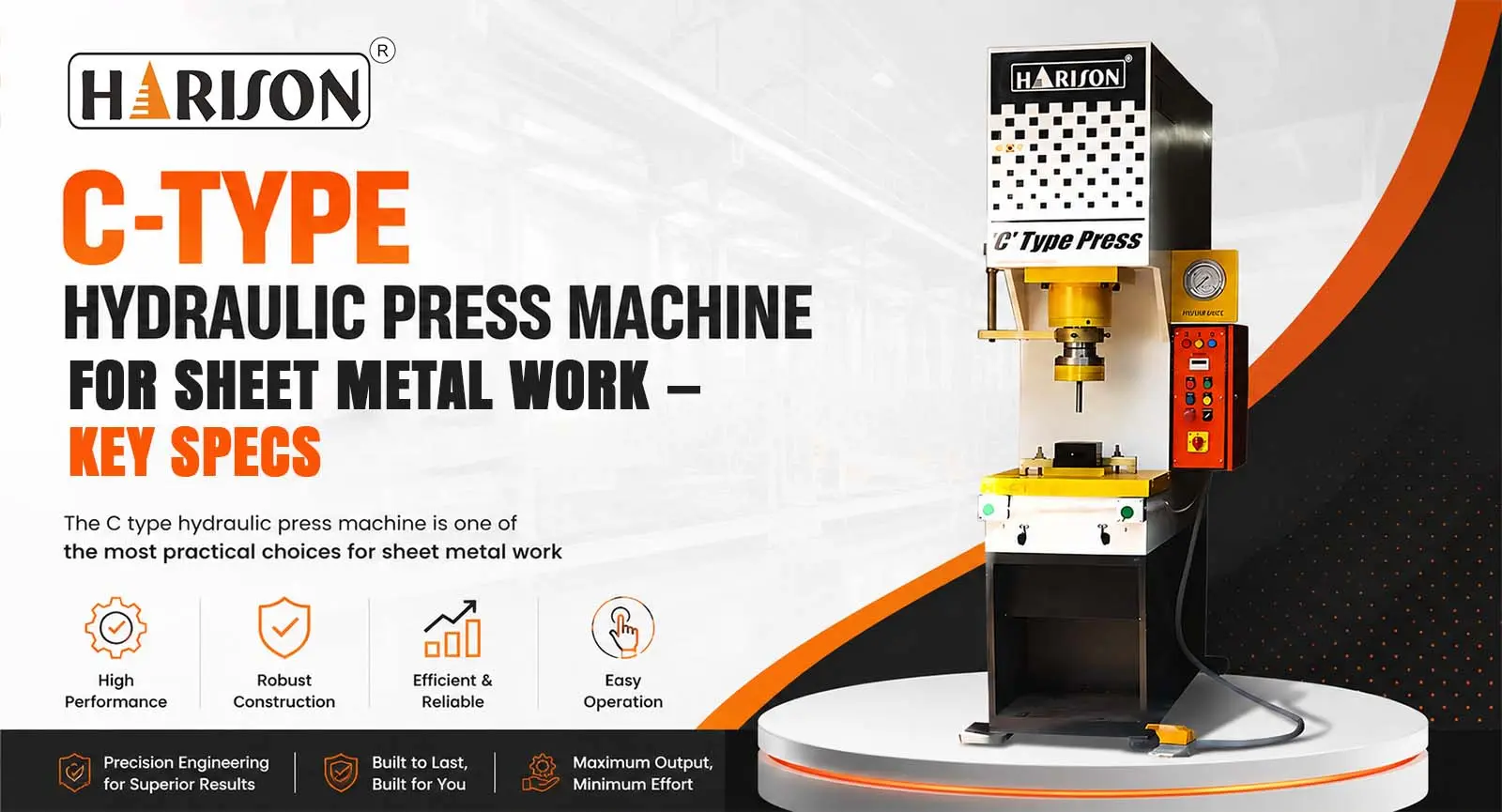
Sheet metal fabrication covers a wide range of operations — punching, blanking, bending, forming, embossing, deep drawing — and each one places specific demands on the press doing the work. Buy a press that’s too small and you’re either underproducing or overloading the machine regularly. Buy the wrong frame type and loading becomes slow and awkward, adding time to every cycle. The C type hydraulic press machine has become a preferred choice across small and mid-size sheet metal shops precisely because it balances access, capacity, and versatility in a single compact design. But getting the specification right before the order is what determines whether it actually works for the application.
What Is a C Type Hydraulic Press Machine?
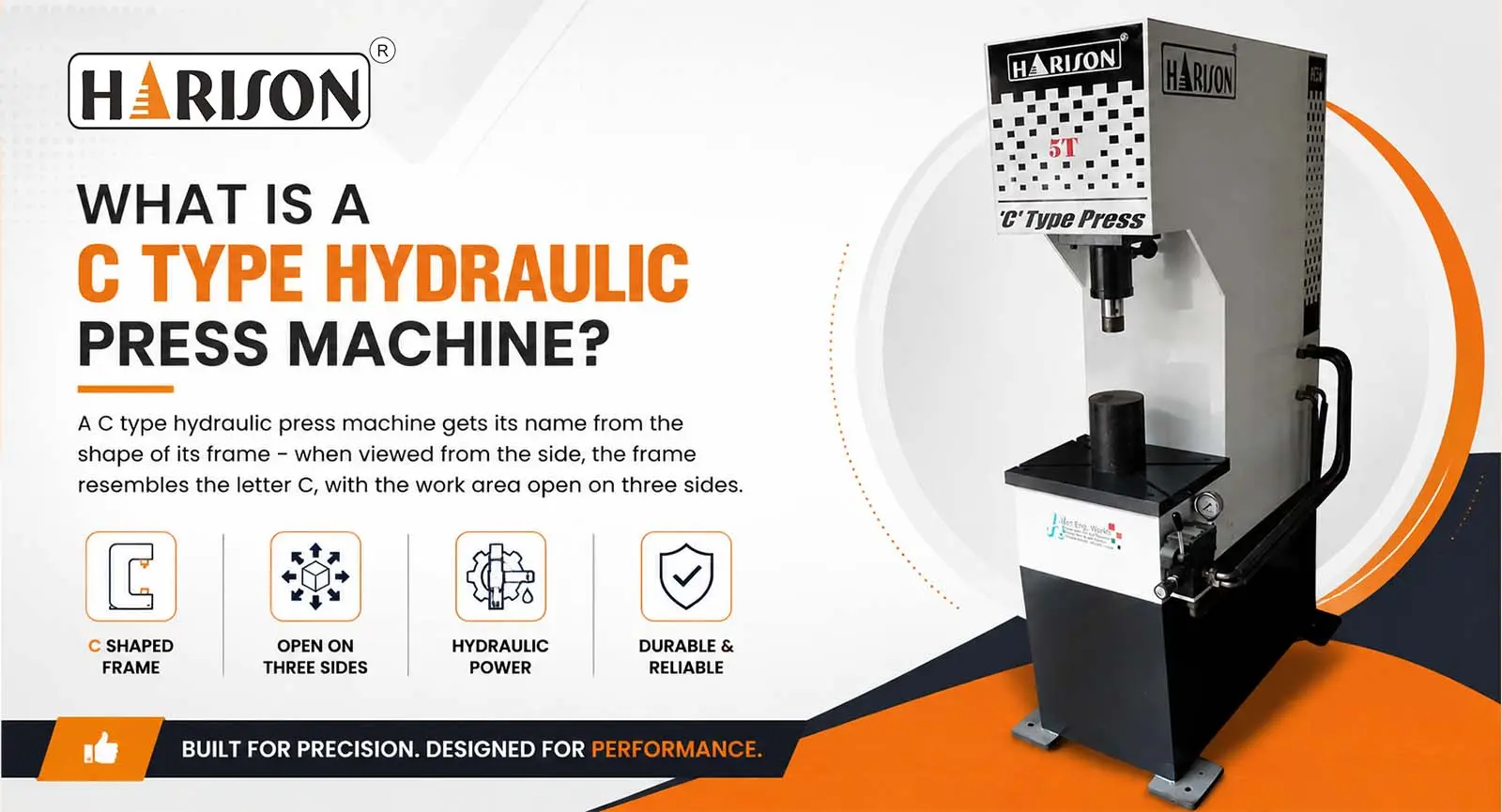
A C type hydraulic press machine gets its name from the shape of its frame — when viewed from the side, the frame resembles the letter C, with the work area open on three sides. The hydraulic cylinder is mounted at the top of the frame, and the ram moves vertically down onto the work piece sitting on the bed below.
Key structural components:
- C-shaped frame — a single-piece or fabricated steel frame that provides the structural rigidity while leaving three sides open for access
- Hydraulic cylinder and ram — the cylinder sits in the crown of the frame and drives the ram downward with hydraulic pressure
- Bed or bolster plate — the fixed lower surface on which tooling and work pieces are placed
- Hydraulic power unit — the pump, motor, reservoir, and valve assembly that generates and controls hydraulic pressure
- Control panel — manages ram speed, pressure, stroke length, and cycle mode
The open-front design is what distinguishes the C frame from a four-column or H frame press — and for sheet metal work, that open access is often what makes the difference in practical usability.
Why the C Frame Design Works Well for Sheet Metal?
Sheet metal components come in many shapes and sizes. Long strips, large blanks, formed parts mid-operation — loading these into a closed or four-column press can be awkward. The C type hydraulic press machine removes this problem by leaving three sides of the work area completely open.
Practical advantages for sheet metal:
- Three-sided access — sheets can be fed from the front, side, or rear depending on the operation and part geometry
- Easy die changing — tooling can be changed from multiple angles without dismantling the press setup
- Compact footprint — the C frame takes up significantly less floor space than a four-column press of equivalent tonnage
- Faster loading and unloading — open access reduces cycle time per part, which matters in production environments
- Visibility — operators can see the work piece clearly from multiple positions, reducing setup errors
The trade-off is that the C frame is less rigid than a four-column frame under eccentric loading — which matters when large loads are placed off-centre. For most standard sheet metal operations where the load is reasonably centred, this is not a practical limitation.
Key Specifications of C Type Hydraulic Press Machine
Getting these specifications right is what separates a press that works from one that doesn’t fit the application.
Press Capacity (Tonnage)
The maximum force the press can generate, expressed in tonnes. For sheet metal work, required tonnage depends on the material thickness, material type, and the operation being performed. Blanking and punching require higher tonnage relative to material area than bending or forming.
Common capacities for sheet metal C type presses:
- 10, 20, 30, 50, 63, 100, 150, 200 tonnes and above
Always choose capacity with a margin — working a press at 90–100% of rated capacity continuously reduces its service life.
Stroke Length
The total distance the ram travels from its upper position to the lowest point. For deep drawing and forming operations, sufficient stroke length is critical — a ram that can’t travel far enough won’t complete the operation.
Daylight Opening
The distance between the ram face and the bed when the ram is at its topmost position. This determines the maximum tool height that can fit in the press. Account for the die set height, work piece height, and any additional tooling components when checking this figure.
Bed Size
The dimensions of the working surface — length and width of the bolster plate. The bed must be large enough to accommodate the tooling footprint for the operations planned. For sheet metal work, a larger bed allows more complex progressive tooling to be used.
Ram Speed
Most C type hydraulic press machines offer:
- Rapid advance — fast ram approach before contact with the material
- Press speed — slower speed during the actual forming or cutting stroke
- Return speed — fast return to the top position
Adjustable speed control improves both product quality and cycle time in sheet metal applications.
Working Pressure
The operating hydraulic pressure — typically 100 to 350 bar depending on the press design and capacity. Higher working pressure at a given cylinder bore produces more force.
Throat Depth
On a C frame press, throat depth is the horizontal distance from the centre of the ram to the back of the frame. A deeper throat allows larger work pieces to be processed. For sheet metal operations on wide panels, throat depth can be a limiting factor.
Sheet Metal Operations a C Type Hydraulic Press Handles
A well-specified C type hydraulic press machine covers most standard sheet metal fabrication operations:
- Blanking — cutting flat shapes from sheet stock
- Punching — creating holes in sheet metal
- Bending — forming angles and profiles in sheet material using press brake tooling
- Deep drawing — forming cup and box shapes from flat sheet by drawing material over a punch
- Embossing — creating raised or recessed patterns in sheet metal surfaces
- Forming — general shaping operations that change the profile of a flat blank
- Coining — high-pressure forming that produces precise, consistent surface finish
- Assembly pressing — pressing bearings, bushings, and inserts into sheet metal components
Final Thoughts
Hari Engineering Works manufactures C type hydraulic press machines across a range of tonnages and specifications for sheet metal fabrication, industrial forming, and general pressing applications — with custom configuration options and technical support for specification and installation.
Frequently Asked Questions
Hari Engineering Works
Hari Engineering Works is a trusted manufacturer and exporter of hydraulic press machines based in Rajkot, Gujarat, India. We offer a diverse range of high-quality and cost-effective products to clients worldwide.
